· Diogo Silva · 7 min read
Even a castle in the sky needs roots
On Miyazaki’s Laputa, the uses of power, and the ordinary life our cleverest machines ought to serve.
A few days ago, one of my children asked me whether the blue stone in Castle in the Sky really existed.
A crystal that glows in the dark and keeps an island in the air is certainly worth asking about. The stone is imaginary, but explaining that only takes a moment. Understanding the world it belongs to takes rather longer.
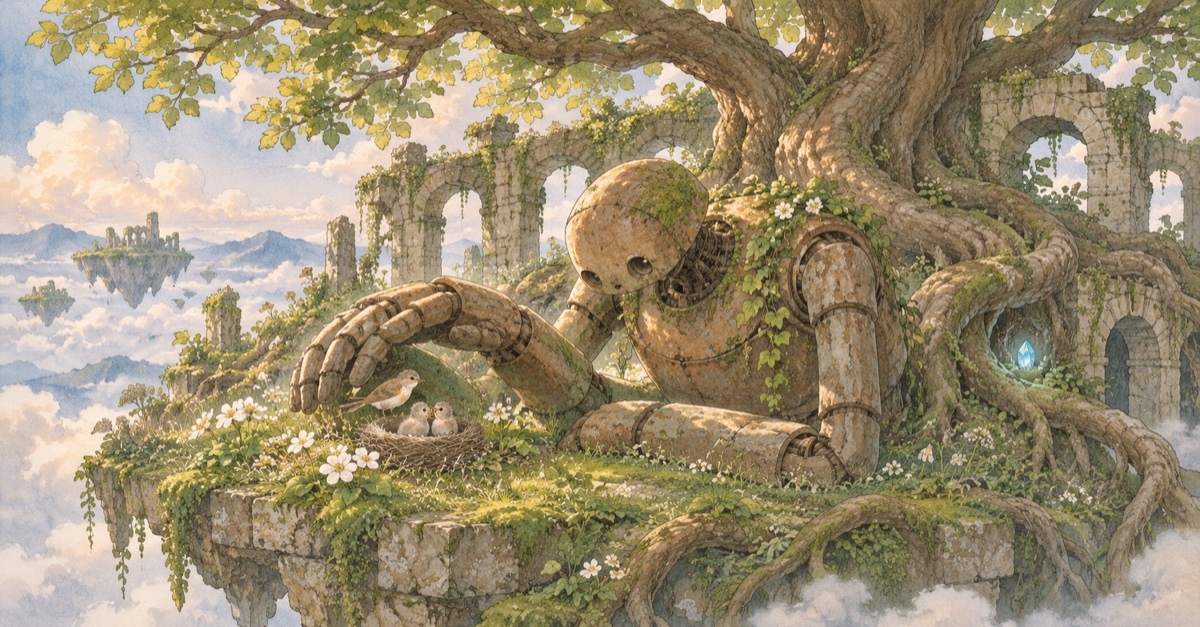
There is a robot in Castle in the Sky that has outlived an empire and still has a garden to look after.
It tends flowers, protects a bird’s nest, and moves through the ruins with a gentleness its enormous body would hardly lead you to expect. Robots of its kind can be terrifying weapons. Here, among the trees, one has found a quieter occupation.
Thinking about my son’s question, I find myself returning to the gardener. There is something about that old machine, still taking care of living things after its masters have gone, that makes our own technological ambitions look rather unfinished.
Hayao Miyazaki’s Castle in the Sky was released in 1986. Forty years later, its central question feels close to home: what is all this power for?
Laputa is a lost city suspended above the earth. Sheeta, a girl carrying a mysterious crystal, and Pazu, a young miner, set out to find it while pirates and the military pursue them. There are flying machines, underground caverns, narrow escapes, and enough wonder to carry the story without requiring a child to extract a lesson from it.
But the wonder has roots of its own.
The name comes from the flying island in Jonathan Swift’s Gulliver’s Travels. Swift imagined a society so absorbed in mathematics and speculation that it struggled with ordinary life. Its island, moved by a vast magnet, also gave its ruler a particularly unpleasant advantage over the people below: he could deprive them of sunlight and rain. Intellectual detachment had acquired a means of enforcing itself.
Miyazaki makes a different story from that inheritance. His Laputa also brings Babel to my mind, with its ambition to establish human power in the heavens, and Atlantis, with its memory of a greatness that could not preserve itself. These are echoes I hear in the film, rather than a key that explains every part of it. A city above the clouds is a beautiful image. It can also express a wish to rise beyond dependence on anyone beneath us.
The world below matters just as much. The film’s mining communities draw on Miyazaki’s visits to Wales in the 1980s. Pazu belongs to a place where people repair machinery, work with their hands, and come to one another’s defence. Even the air pirates have meals to prepare and an engine to keep running. Someone must do the work that allows the adventure to continue.
Even the city’s magic has a connection to the ground. In the mine, Uncle Pom recognises the nature of Sheeta’s crystal in the stones around them. The power that carries Laputa into the heavens has come from within the earth.
That gives the floating city a curious place in the story. We spend much of the film wanting to reach it. When we arrive, there is nobody home.
The machinery still works. The weapons remain appallingly effective. Technical achievement has survived the people whose achievement it was. The film leaves much of their departure unexplained, which makes the empty rooms more troubling than a tidy account of their downfall would have been.
Above the hidden machinery, a great tree has spread through the ruins. Its roots reach deep into the structure and surround the crystal at the island’s heart. Water, birds, small animals, and the patient gardener occupy a place that human rulers once claimed. Below them waits the apparatus of an empire.
Muska, who wants to restore that empire, can see only an opportunity. Possessing its weapons seems to him sufficient qualification to govern the world. Sheeta answers from the memory of a life close to the soil. However formidable their machines become, people still belong to the earth.
I read this as the film’s deepest warning. A civilisation can retain the power to rise above the world while losing the sense of how to live in it.
Our own clouds are less picturesque. They require buildings, electricity, cooling, minerals, and people who maintain them. The language of technology can make those dependencies disappear from view. We speak of intelligence, storage, and automation as though we had finally found somewhere to put human activity where the material world need no longer trouble it.
I work with software and use artificial intelligence every day. There is real pleasure in making a useful tool, especially when it takes a tedious task out of someone’s hands. With five children, useful machinery has an excellent chance of earning my gratitude.
Yet the hours it saves still need a purpose. A task that once took an afternoon may now take minutes. The remaining time can become another task, then another, until the whole afternoon is occupied again. At home, the people who might have enjoyed some of those hours can be forgiven for finding the improvement difficult to detect.
It is easy to picture an ordinary evening: a child halfway through a story, while my attention has already gone back to something I am building. Nothing has broken. Work may be going extremely well. But I am beginning to understand the attraction of a magnificent city where nobody lives.
Family brings these questions down to a scale at which I can answer them. There is someone to listen to, a meal to help with, a promise that has reached the hour when it must be kept. Such things give a practical meaning to the time I claim to value. Children grow through the days we are having now. There is no later version of this particular evening to which I can return once the work is finished.
The gardener offers a useful measure here. Its strength is expressed through care for something smaller and more vulnerable than itself. It has the precision to avoid doing harm. That seems a worthy ambition for the things we build: to make them attentive to the life around them, and to judge their usefulness by what they help sustain.
Good intentions alone will not settle the question. The design of a tool, the habits it encourages, and the power it puts within reach all deserve judgement. Laputa’s weapons require more than a reassuring promise about who will operate them next.
This is where the ending becomes difficult and beautiful. Sheeta and Pazu speak the destructive spell together. They relinquish a kingdom they might have claimed, knowing what its power could do. The military structure breaks apart and falls away. The great tree survives, its roots holding the crystal, and the garden rises into the sky.
The surviving island still flies. The children themselves escape in a glider. There is room in Miyazaki’s world for invention and for the joy of flight. What has been surrendered is the claim to rule through overwhelming force. The gardener remains with its living charges.
As a father, I find something hopeful in that ending. Children are given an adventure in which courage includes the willingness to give up power. They can admire the marvellous machine and care about the bird’s nest. They are trusted to understand why keeping one may require refusing another.
My own faith gives this care a further meaning. The world is something received, entrusted to us for a time. A garden, a household, and the people whose lives have become joined to ours ask more of us than cleverness. We have duties towards them even when those duties interrupt something interesting.
I want my children to be capable people. I hope they will learn to make things, use tools well, and take pleasure in difficult work. Alongside that, I hope they acquire some affection for what they cannot hurry: a tree growing, a friendship deepening, a home becoming familiar through years of being cared for.
Much of what I build is meant to make room for such a life. Remembering that should help me recognise when it is time to close the computer and join it.
My son wanted to know whether the stone was real. I hope, in time, he will remember the gardener too.
Somewhere above the clouds, a very old machine is getting on with the gardening.