· Diogo Silva · 6 min read
From company towns to flexible benefits
Long before Portugal had a welfare state, industrial pioneers built housing, schools and hospitals to keep skilled people. Two centuries later, technology has finally made serious employee benefits accessible beyond giant corporations.
It is easy to assume that employee benefits are a recent human-resources fashion imported alongside open-plan offices. In Portugal, that gets the history backwards. Long before the country had a comprehensive public welfare system, private industrialists were already organising housing, schooling, subsidised meals and healthcare around their workforces.
They did not act out of sentiment alone. They understood an economic reality that still holds today: gross pay rarely keeps skilled people together for long when ordinary family needs—a home, a child’s school, a doctor, a daily meal—remain exposed or lose value before reaching the household budget.
1. The industrial pioneers: Vista Alegre and CUF
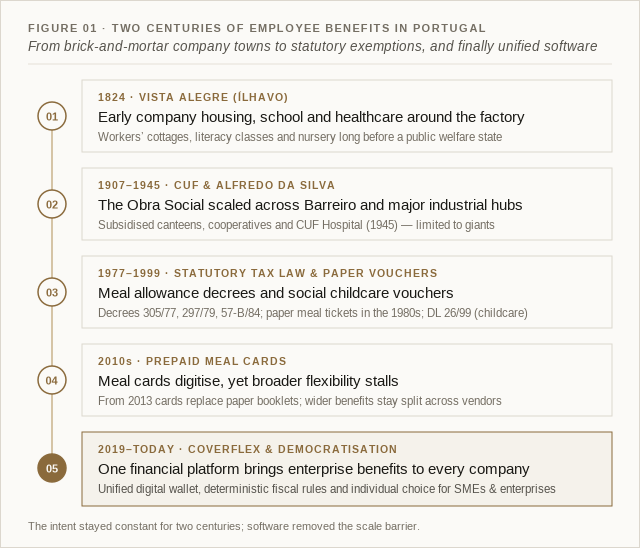
Portugal’s earliest clear precedent dates to 1824. When José Ferreira Pinto Basto founded the Vista Alegre porcelain works in Ílhavo, he built a community alongside the factory: dedicated workers’ housing, a nursery and primary school, adult literacy classes, basic healthcare, and cultural societies. In a rural nineteenth-century Portugal with virtually no state safety net, household stability made skilled craft possible.
In the first half of the twentieth century, Alfredo da Silva took that logic to industrial scale at CUF (Companhia União Fabril), centred in Barreiro. Through CUF’s Obra Social, the group ran entire workers’ neighbourhoods, subsidised canteens, consumer cooperatives selling staples at cost, nurseries, vocational schools, internal pension funds and permanent clinics—culminating in the CUF Hospital in 1945 for tens of thousands of workers and their families.
There is no reason to romanticise the paternalism of the period, which carried real power asymmetries and grew alongside an authoritarian regime. Yet two lessons endure. First, benefits were treated as serious economic infrastructure, not decorative perks. Second, the model had a hard ceiling: when care meant laying bricks and employing doctors, only industrial giants could afford it.
2. From bricks to tax law: meal allowances and social vouchers
After 1974 and the expansion of Portugal’s public welfare state, private employers stopped building towns and hospitals. Yet the practical tension remained: how to strengthen employees’ purchasing power without pricing companies out of hiring. Benefits moved from physical bricks into tax law.
Portugal’s modern framework emerged in four clear steps:
- 1977–1984 (The meal allowance framework): Decree-Law no. 305/77 (29 July 1977) created a uniform civil-service meal allowance. Decree-Law no. 297/79 (17 August 1979) extended tax-exemption rules to private employers up to the public-service cap, and Decree-Law no. 57-B/84 (20 February 1984) clarified that it was a social benefit tied to days worked rather than a disguised pay supplement.
- 1980s (Paper meal tickets): Specialist issuers such as Ticket Restaurant, arriving around 1984, allowed firms without canteens to subsidise daily meals, a practice later reinforced by stronger tax exemptions for vouchers over cash.
- 1999 (Childcare vouchers): As dual-income households became standard, Decree-Law no. 26/99 (28 January 1999) introduced social childcare vouchers (vales infância), enabling employers to co-fund nurseries and kindergartens with Social Security exemptions and corporate tax relief.
- 2010s (From paper to prepaid cards): From 2013 onwards, paper booklets rapidly gave way to electronic meal cards, improving everyday convenience across restaurants and supermarkets.
3. The quiet bottleneck: why flexibility stayed locked inside multinationals
Even once meal cards became routine, a stubborn gap persisted. On paper, Portuguese tax law offered attractive room beyond meals: employer Social Security (TSU, 23.75%) exemptions on eligible flexible benefits, childcare and education support, healthcare, public transport, retirement savings (PPR) and work technology. On meal allowance alone, paying €10.455 per day by card instead of the €6.15 cash ceiling (effective January 2026 under Portaria n.º 51-B/2026) puts €94.71 per 22-day working month in additional tax-free net value into an employee’s pocket.
In practice, however, broader flexibility stayed locked inside large corporations because the operational burden was punitive. Offering more than meal cards meant juggling separate contracts for vouchers, insurers and reimbursements, plus monthly payroll reconciliation. A 35-person firm or regional clinic rarely had a compensation team to manage five disconnected vendors.
Even inside larger organisations, packages were often built for an imaginary “average employee”. A twenty-four-year-old paying rent, a parent paying nursery fees, and a senior director planning retirement received the same fixed perk—leaving much of the budget underused.
4. Democratisation through technology: what Coverflex changed
That operational bottleneck is what Coverflex—founded in Portugal in 2019, and the company where I work today—set out to remove through technology.
The breakthrough was not inventing new tax exemptions; the legal blocks already existed. It was turning fragmented manual administration into unified financial software. By combining meal allowances, flexible benefits wallets, insurance and discounts in a single platform, mobile app and card, the administrative overhead collapsed.
- One operational rail instead of five vendors: HR and Finance manage budgets, eligibility rules, consolidated invoicing and ERP payroll exports in one place, backed by deterministic tax rules rather than manual guesswork.
- Individual choice without HR chaos: Each employee allocates available funds to what genuinely matters in their household that year—childcare, schooling, health, mobility, technology or retirement savings—without creating extra tickets or spreadsheets.
- Enterprise compensation for SMEs: For the first time in Portugal, a twenty-person business can offer the same fiscal efficiency and personalisation as a five-thousand-person group.
5. What endures across two centuries
From Vista Alegre in 1824 to a flexible benefits wallet in 2026, the thread is remarkably consistent. Employers who take retention seriously eventually recognise that how compensation reaches a family matters nearly as much as the gross figure in a contract.
The difference today is that doing it well no longer requires building neighbourhoods around a factory or maintaining an administrative department to sort paper vouchers. As I argued in Giving the client the tools to decide, organisations move when financial rigour meets operational simplicity. Software has finally put both within reach of the wider Portuguese economy—turning employee benefits from a privilege of industrial giants into a practical tool for companies of every size.
Sources
- Portaria n.º 51-B/2026 — Diário da República — Sets the public-administration meal allowance base at €6.15/day, effective 1 January 2026.
- Código do IRS (Artigo 2.º) — Portal das Finanças — Exempts meal allowances up to the statutory cash base and up to +70% when paid via meal card or voucher (€10.455/day in 2026).
Written by hand by Diogo Silva · · View Markdown
https://diogobronzesilva.com/notes/from-company-towns-to-flexible-benefits/